India Country Brief: The Anthropic Economic Index

Executive summary
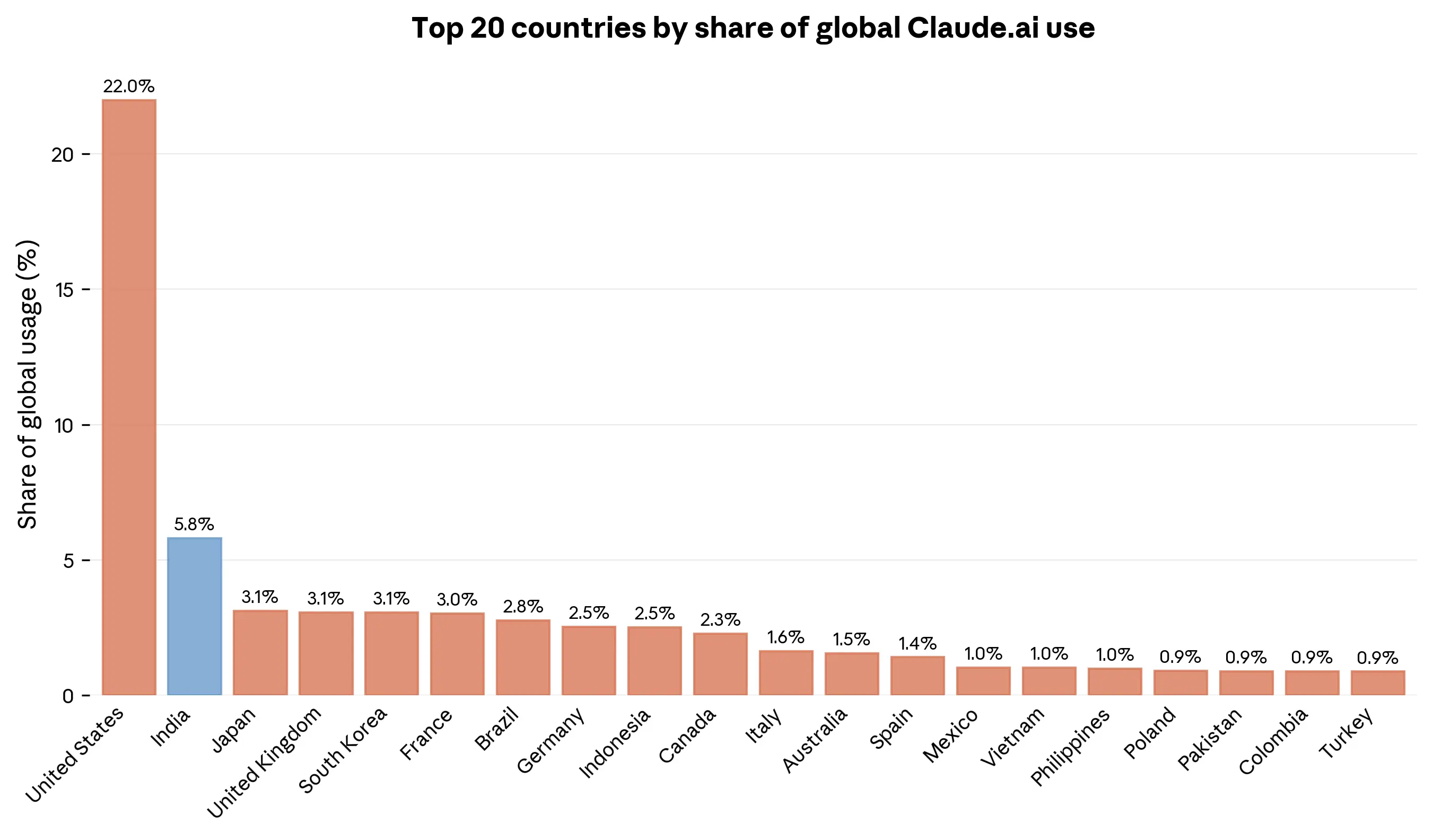
India, already the world’s largest exporter of IT services, is home to one of the world’s fastest-growing AI user bases. Understanding how AI is being used in India—and how it differs from other countries—is essential for informing AI policy, investment, and deployment in the country. This brief provides insights on Claude.ai use in India, drawing on data from the fourth Anthropic Economic Index report covering ~1 million Claude.ai conversations globally during November 2025. India accounts for 5.8% of total Claude.ai use, second only to the United States. Yet current adoption remains concentrated, pointing to significant opportunities to expand access more broadly across the population.
The findings point to a user base that applies AI more heavily in professional contexts, delegates more autonomy to it, and brings Claude tasks that are substantially more time-consuming to complete without assistance. Higher shares of complex tasks that humans could not complete alone suggest that Indian users are using the technology at the frontier.
India is among the leading countries in global AI adoption
India ranks second among all countries by share of total Claude.ai use, trailing only the United States. However, on a per-capita basis, adjusting for the working-age population, India ranks 101st out of 116 countries with sufficient observation volume, below other countries in Asia such as Singapore or Malaysia. This gap suggests that India’s high Claude use overall reflects the sheer size of its population, not that the average person is using Claude heavily. This points to significant opportunities to increase adoption.
Concentrated use within India
Geographic concentration
Use is concentrated in a small number of highly economically active states. Maharashtra, Tamil Nadu, Karnataka, and Delhi together account for over half of India’s total Claude.ai use. This pattern closely mirrors India’s IT sector geography and urban economic output.
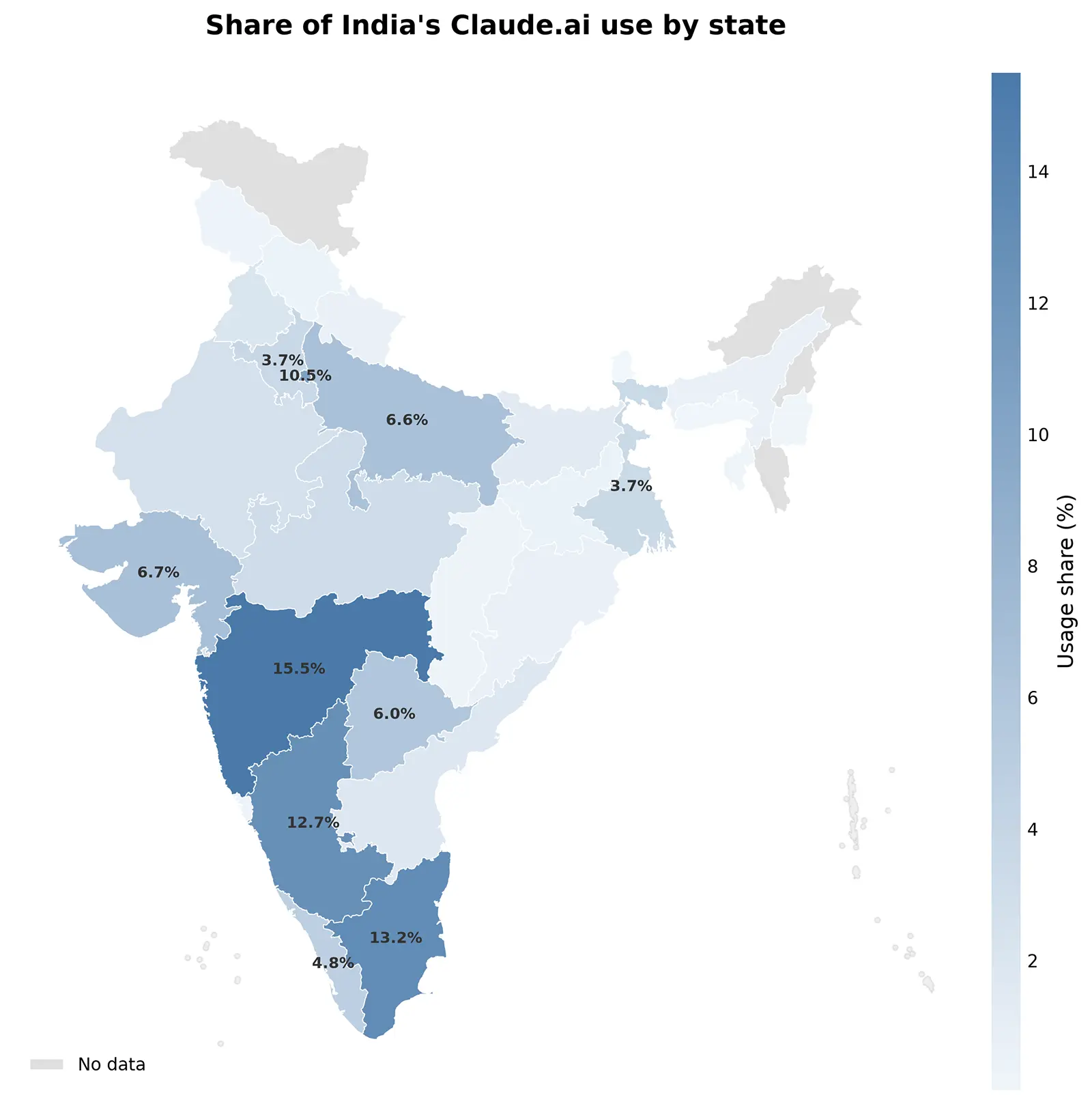
The concentration in these four states—home to Bangalore, Hyderabad, Chennai, Mumbai, and Delhi NCR—suggests that current AI adoption is driven primarily by India’s established technology workforce rather than broad-based consumer uptake.
Concentration of occupational tasks
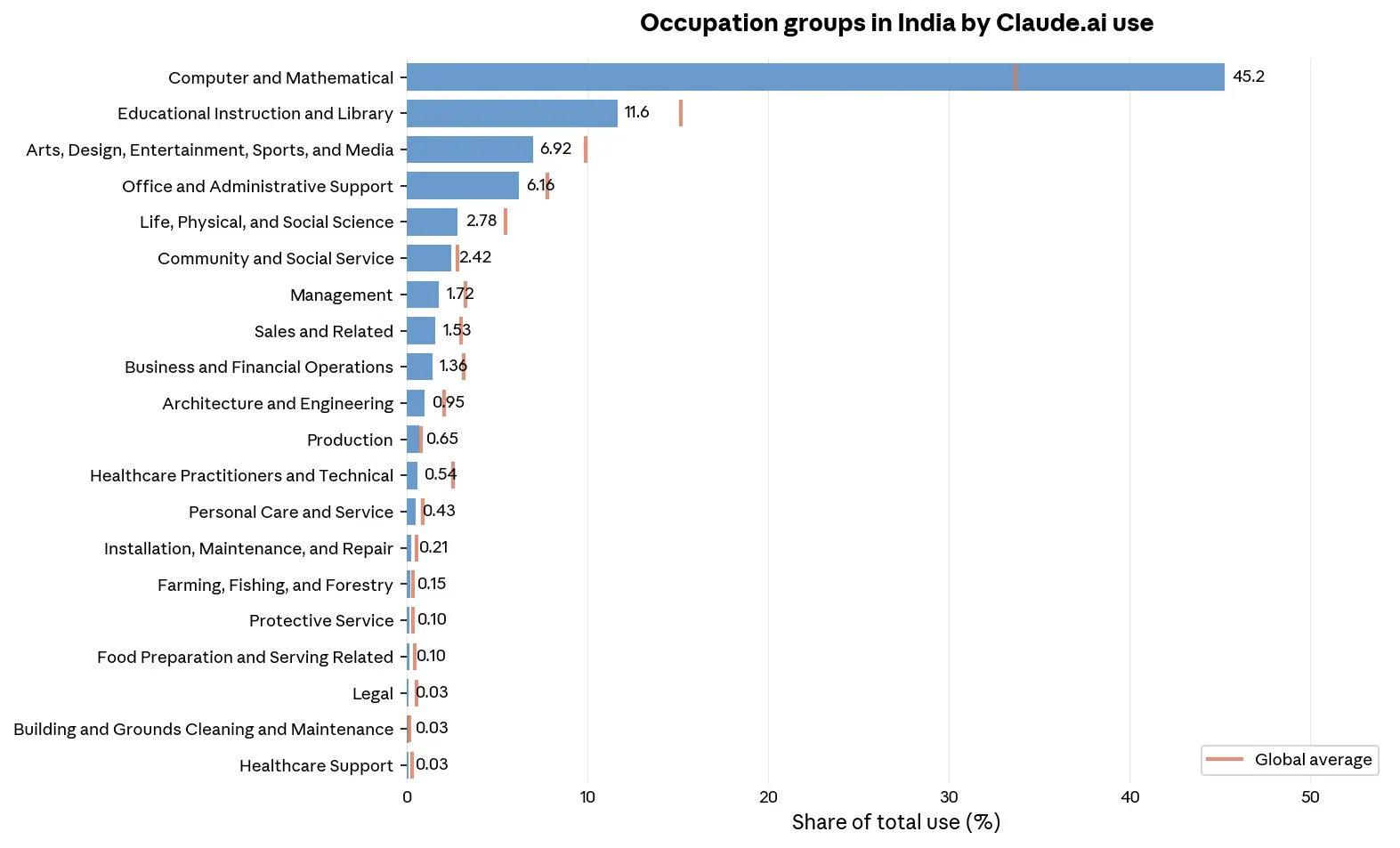
The occupational mix of Indian Claude.ai use, inferred by mapping tasks to related occupations, skews towards software development and engineering roles, consistent with the country’s large IT services sector.
The most common O*NET tasks performed by Indian users confirm the software-heavy profile:
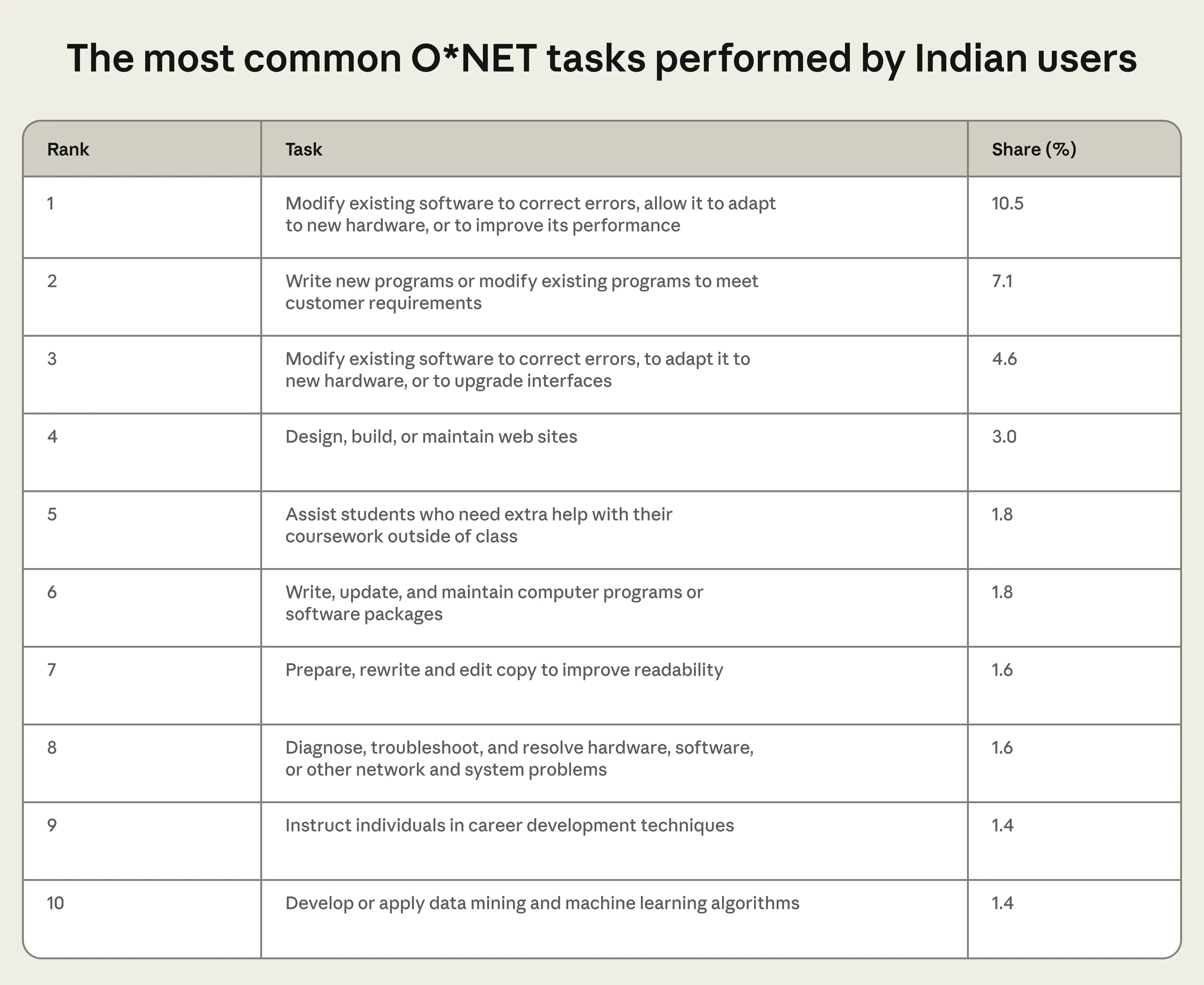
India ranks 1st globally in the share of AI use devoted to software-related tasks (45.2% of all O*NET-mapped tasks), ahead of Vietnam (42.1%) and Egypt (39.2%). The presence of educational tasks among the most common individual tasks (see Table 1) and when aggregating tasks to occupation groups (see Figure 3) indicates other common use cases in learning and instruction.
Economic primitives: how India uses AI differently
Our latest Economic Index report introduces “economic primitives”—fundamental measurements of how humans and AI collaborate. Comparing India to the global average reveals several distinctive patterns.
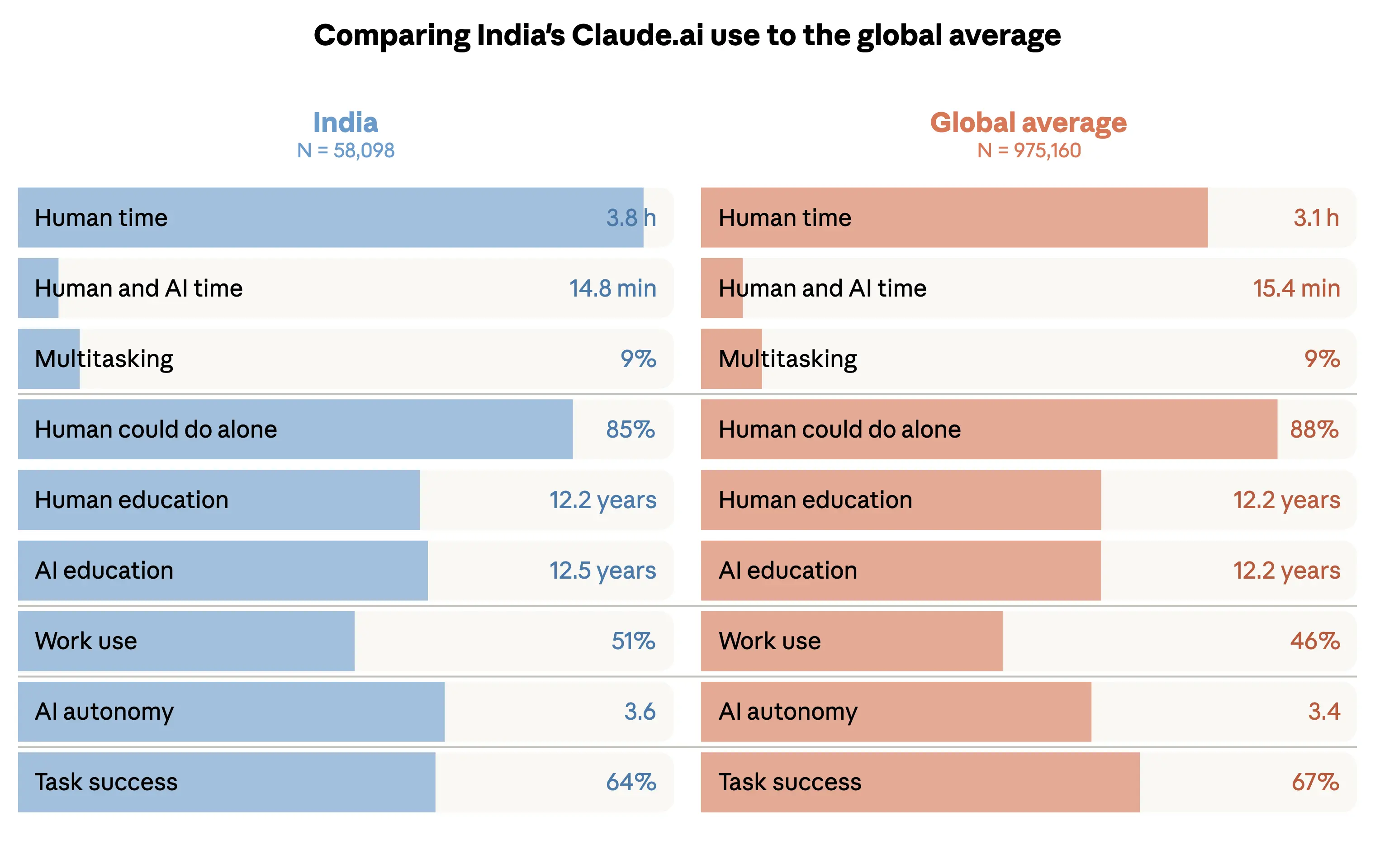
Greater productivity speedup. Indian users take on average 14.8 minutes to complete tasks with AI that would take 3.8 hours without AI—a 15x speedup. Globally, users take on average 15.4 minutes to complete tasks that would take 3.1 hours without AI—a 12x speedup. This suggests that AI is delivering outsized productivity gains on the more complex tasks Indian users bring to it.
Stronger work orientation. 51.3% of Indian Claude.ai use is work-related, compared to 46% globally. Coursework accounts for 20.9% (vs. 19.3% globally) and personal use for 27.8% (vs. 34.7% globally). The work-heavy, lower-personal-use profile is consistent with India’s large professional services sector and the finding from the main report that lower-GDP-per-capita countries tend towards work and coursework over personal use.
Higher AI autonomy. Indian users delegate more decision-making autonomy to AI (3.60 vs. 3.38 globally on a 1–5 scale, where 1 means no delegation and 5 means extreme delegation). This suggests greater willingness to let AI operate independently rather than using it purely as an assistant.
Lower human-only ability. One of the data points we measure is whether AI is being used to do something a human couldn’t do on their own, like writing code in a language they don’t know. We find that 84.6% of tasks could be completed by a human alone (vs. 87.9% globally), suggesting Indian users more frequently bring tasks to AI that they could not easily accomplish independently.
Prompting skills matter. As a proxy for the skills humans and AI bring to the conversation, we estimate the years of education someone would need to understand the user prompt or the AI response in a conversation. We find that the human education level of prompts (12.2 years) and AI education level of responses (12.5 years) are relatively similar, mirroring a global pattern where input quality shapes output quality. Comparing country averages for AI education, India ranks in the top 10%, indicating Indian users are getting sophisticated outputs from Claude.
Implications
Broadening AI’s economic impact will require looking beyond software and IT services. 45.2% of tasks map to software-related occupations—the highest share of any country. Four states (Maharashtra, Tamil Nadu, Karnataka, and Delhi) account for over half of all use. This mirrors the geography of India’s IT sector and suggests that current AI adoption is largely an extension of existing professional strengths and workflows focused on IT.
Investing in AI can provide substantial and measurable productivity gains. Indian users apply AI to tasks that would otherwise take 3.8 hours, compressing them to ~15 minutes—a 15x speedup, compared to 12x globally. This means that India is already extracting significant value from AI: bringing harder tasks and compressing the time needed to complete these tasks further than the global average.
Closing the gap between absolute and per-capita use requires addressing structural barriers. India ranks 2nd in total use but 101st in per-capita use. The gap between these two figures reflects both India’s large population and how narrowly concentrated current adoption is. Globally, per-capita AI adoption is strongly correlated with per-capita income. India’s per-capita use is consistent with what this relationship would predict. Without addressing structural barriers related to income, digital infrastructure, and awareness outside the IT sector, Indian AI adoption is likely to remain concentrated.
Embracing AI autonomy appears to be serving Indian users well. Higher autonomy scores, longer baseline task times, and frequent use for tasks humans could do alone suggest that Indian professionals are trusting AI to make decisions and using it to enhance human capabilities.
Investing in AI skills could have high returns. The strong correlation between prompt sophistication and response quality in the global data suggests that training programs focused on effective AI use—particularly for workers outside India’s current IT-heavy user base—could meaningfully improve the returns from wider AI adoption.
Methodology
This analysis draws on privacy-preserving data from Claude.ai consumer use from November 13–20, 2025, as described in the fourth Anthropic Economic Index report. Economic primitives are computed using the methodology detailed in that report. Geographic assignment uses IP-based geolocation. Occupation and task classification are based on mappings to the O*NET task taxonomy and SOC occupation groups. For country-level rankings, we only include countries with at least 200 observations in our sample because of the uncertainty of the measure for low-usage countries in our random sample. The underlying data includes Claude.ai Free, Pro, and Max usage.
For the full methodology, global findings, and time-series analysis, see the Anthropic Economic Index January 2026 report.
Citation
@online{appel2026indiacountrybrief,
author = {Ruth Appel},
title = {India Country Brief: The Anthropic Economic Index},
date = {2026-02-16},
year = {2026},
url = {https://www.anthropic.com/research/india-brief-economic-index},
}Acknowledgements
Sally Aldous, Jake Eaton, Ria Strasser Galvis, Hanah Ho, Maxim Massenkoff, Peter McCrory, Jared Mueller, Emily Pastewka, Sarah Pollack, Nitarshan Rajkumar, David Saunders, Alexandra Sanderford, Kim Withee.
Related content
What do you want from AI?
We’re launching a new study using Anthropic Interviewer to learn from your experiences with AI, and we invite you to participate.
Read moreGLM-5.3 and the spread of advanced cyber capabilities
Like Claude Mythos Preview, GLM-5.3 has strong capabilities for autonomously building end-to-end cyber exploits. But GLM-5.3 is unlike other frontier models in that it has been released without meaningful safeguards to limit misuse.
Read moreYes, Claude can do Nine Loops
Guest writer and physicist Matt von Hippel shares what happened when he issued a challenge to AI companies to solve a problem in his former subfield of theoretical physics.
Read more