Introducing Claude Sonnet 5

Claude Sonnet 5 is built to be the most agentic Sonnet model yet. It can make plans, use tools like browsers and terminals, and run autonomously at a level that, just a few months ago, required larger and more expensive models.
For many developers, the agentic AI era began with Sonnet-class models: Claude Sonnet 3.5, 3.6, and 3.7 were the first models that showed impressive skills in coding and tool use. More recently, though, the clearest gains in agentic capabilities have been in our Opus-class models.
Sonnet 5 narrows the gap: its performance is close to that of Opus 4.8, but at lower prices. It’s a substantial improvement over its predecessor, Sonnet 4.6, on important aspects of agentic performance like reasoning, tool use, coding, and knowledge work:
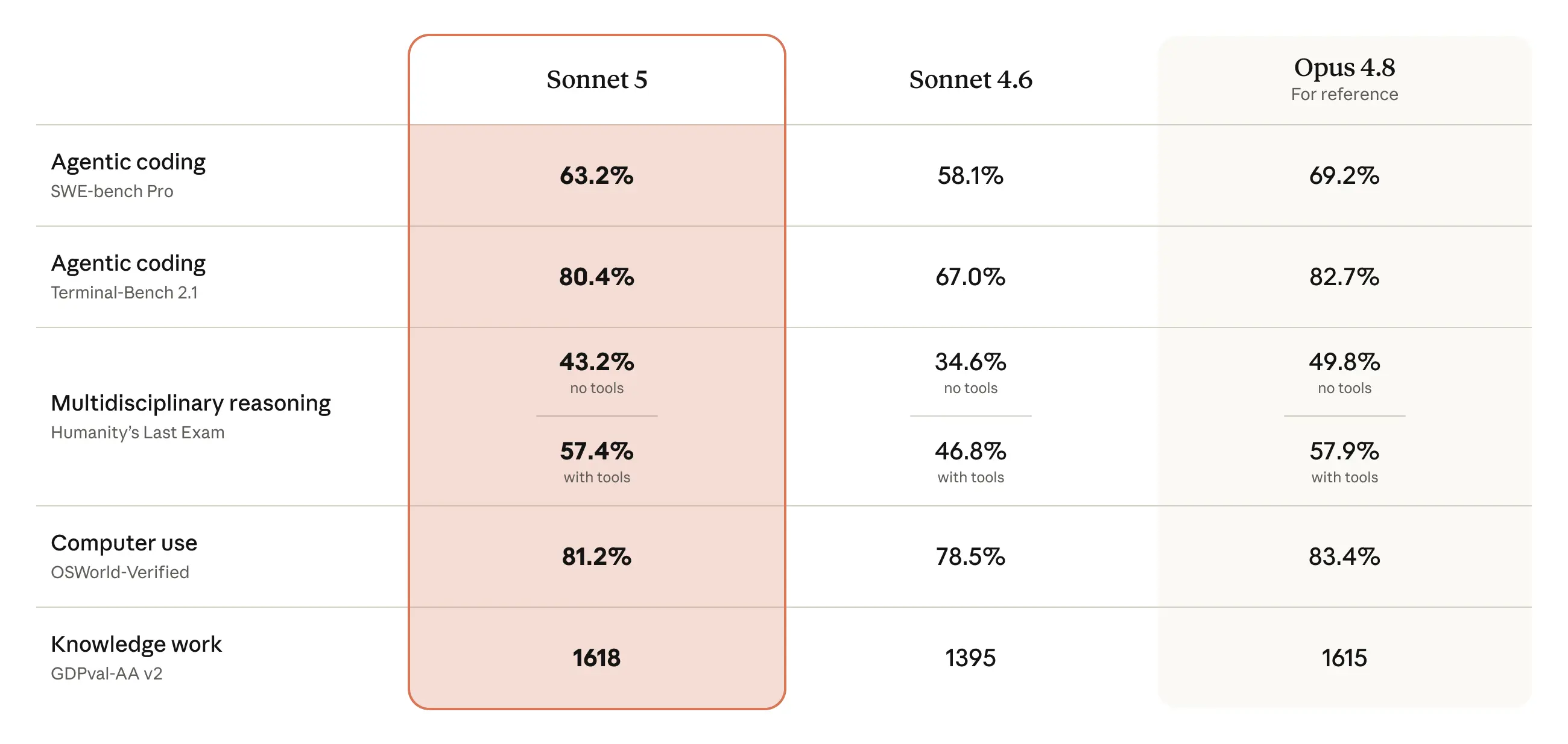
Our safety assessments found that Sonnet 5 shows an overall lower rate of undesirable behaviors than Sonnet 4.6, and is generally safer to use in agentic contexts. Evaluations also show that it has a much lower ability to perform cybersecurity tasks than our current Opus models.
From today, Claude Sonnet 5 is available across all plans: it is the default model for Free and Pro plans, and is available to Max, Team, and Enterprise users. It is priced at $2 per million input tokens and $10 per million output tokens. Developers can use claude-sonnet-5 via the Claude API.
Working with Claude Sonnet 5
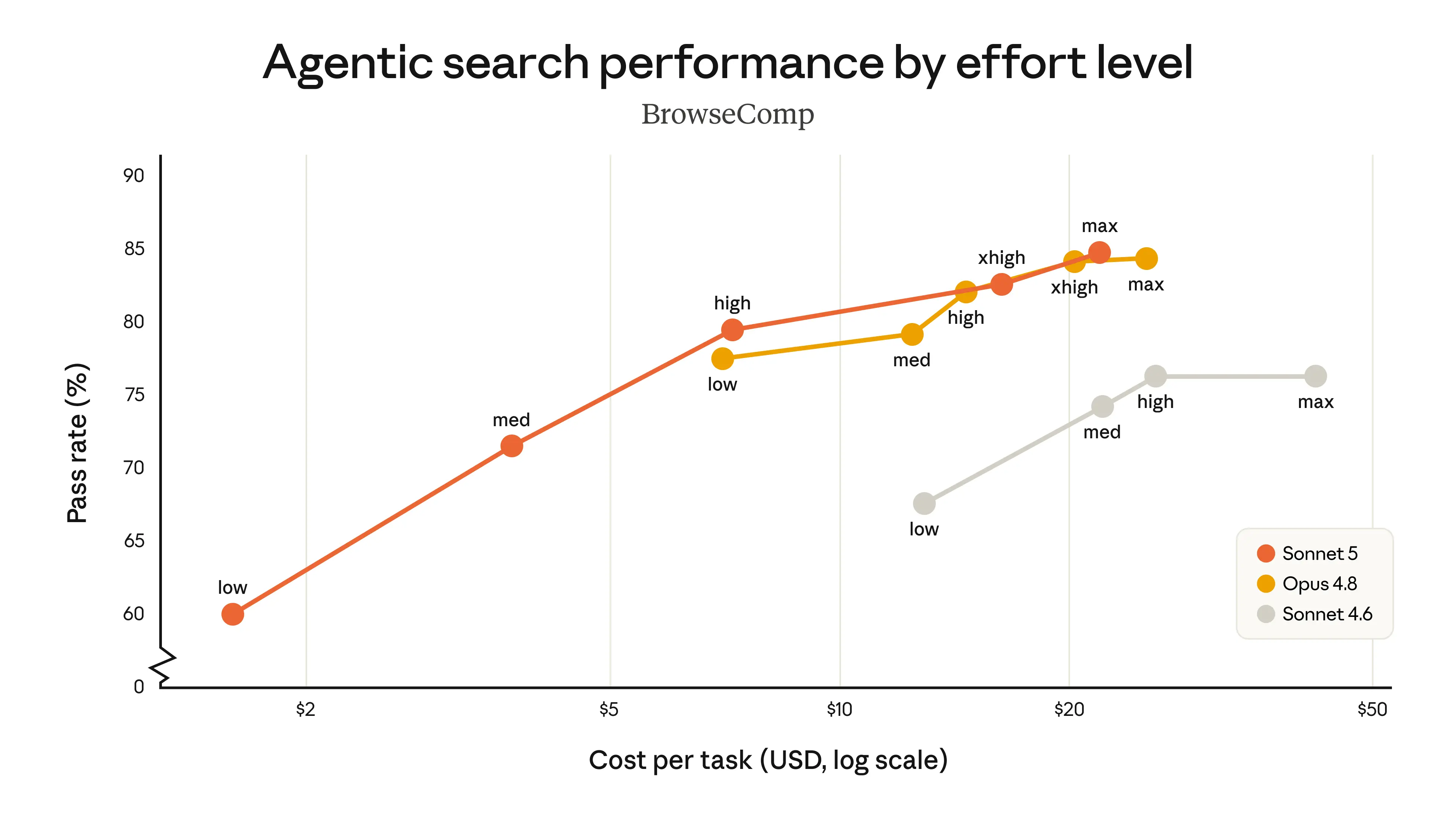
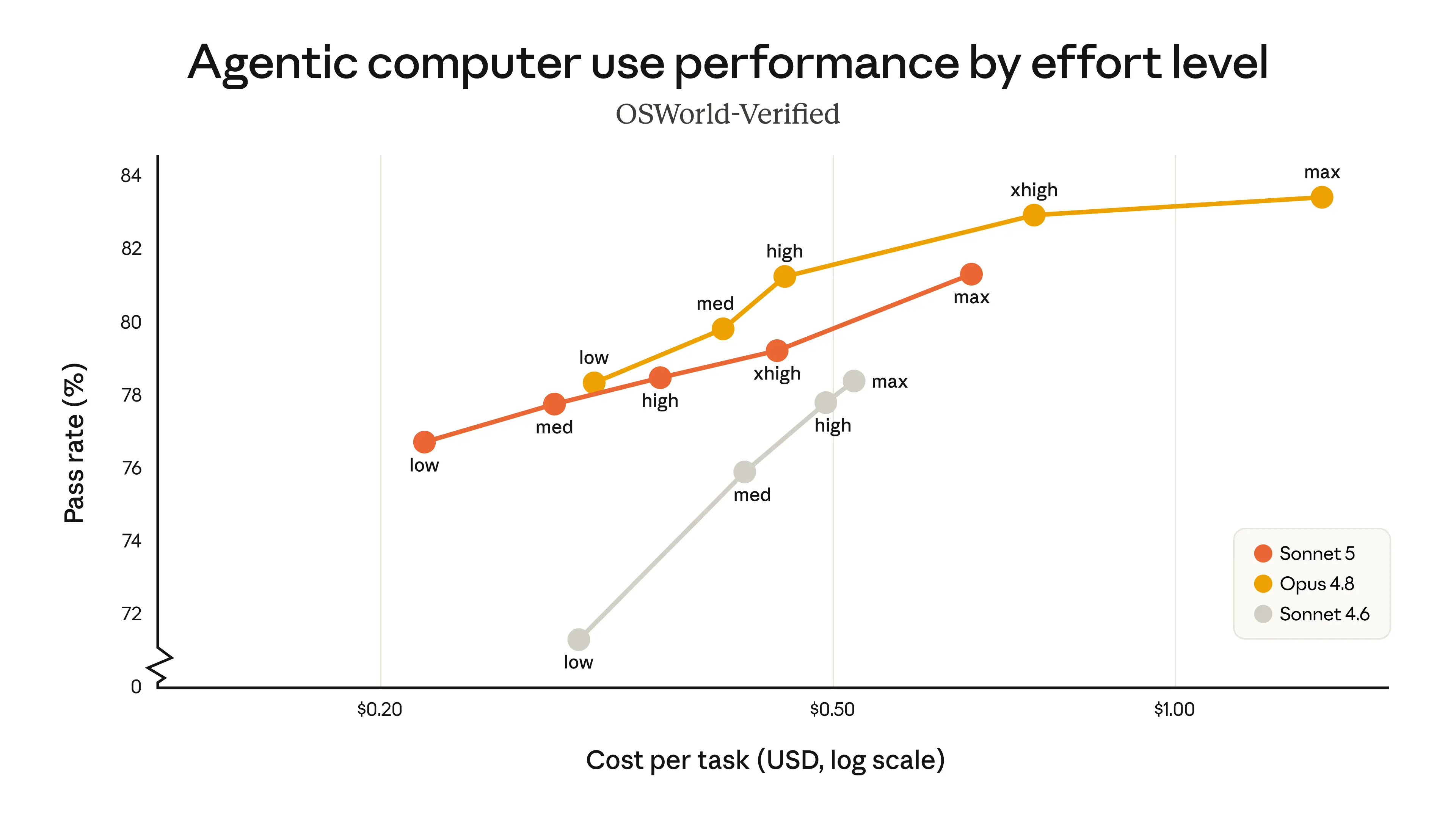
The charts below compare the performance of Sonnet 5 with Sonnet 4.6 and Opus 4.8 at different effort levels on the agentic search evaluation BrowseComp and the computer use evaluation OSWorld-Verified. Sonnet 5 (orange line) is a strict improvement over Sonnet 4.6 (gray line) and covers a much wider range of cost-performance options than Opus 4.8 (yellow line). It provides substantially improved cost efficiency at medium effort; its higher-effort performance can match Opus 4.8 on some tasks. Between Sonnet 5 and Opus 4.8, users can adjust the effort level to find the right balance of cost and performance.
Feedback from our early access partners has been consistent: Sonnet 5 is much more agentic than its predecessors. Testers described how it finishes complex tasks where previous Sonnet models would stop short, how it checks its own output without explicitly being asked, and how it does all this agentic work at an attractive price point:

Claude Sonnet 5 gives our agents a strong execution layer for multi-step software engineering work. It handles sustained coding, tool use, and debugging well across messy technical contexts, and has been especially useful for workflows where follow-through and technical grounding matter.

We handed Claude Sonnet 5 a two-part job—update Salesforce account tiers, send a launch announcement to enterprise contacts—and it finished end to end. That used to stall halfway. For day-to-day automation, it’s a no-brainer.

Claude Sonnet 5 gets more done with less. Same output quality, fewer steps to get there. It refuses unsafe requests cleanly and consistently, too. At Lovable, we’re putting powerful tools in the hands of millions of builders. A model that knows when to say no is just as important as one that knows how to build.

We ran Claude Sonnet 5 against dozens of our most challenging real pull requests, and it carried each one through to a tested, verified result on its own — freeing our engineers to focus on the judgment, the decision, and the final sign-off.

I asked Claude Sonnet 5 to investigate a bug. Unprompted, it wrote a reproducing test, implemented the fix, then stashed it to confirm the bug came back without the change. All in a single pass.

With Claude Sonnet 5, agents stay on plan, follow our conventions, and ship clean multi-step changes, all at an efficient cost.

Claude Sonnet 5 is at its best on brownfield code—race conditions, hidden tests, the parts nobody wants to touch. It traces a failure to its actual root cause and ships a durable fix instead of patching the symptom.

Claude Sonnet 5 sits on the Pareto frontier for Eve’s plaintiff-law tasks. We see the clearest gains in legal research and analysis, at a price-to-performance ratio that made the choice to migrate easy.

ClickHouse agents explore live data and produce insights on the fly, so time-to-insight matters when testing new models. Claude Sonnet 5 reasons in tighter steps and gets our users to answers noticeably faster. That speed is a difference our customers feel.

At Pace, our computer-use agents run insurance workflows—submission intake, FNOL, loss runs—on the systems our operations teams already use. Claude Sonnet 5 consistently takes the right action and does it quickly, which is what real insurance work demands.

For enterprise teams managing high-volume, complex workloads, Claude Sonnet 5 represents a genuine step forward — strong performance where it counts, with the speed and cost profile that makes scaling practical. On several complex tasks it exceeds the current frontier, while delivering fast responses at low costs. For enterprises running at scale, that's a real operational win.

Claude Sonnet 5 handled the full range of coding tasks we tested it on, while resolving more issues. It's a meaningful improvement to both quality and efficiency.

Claude Sonnet 5 is a strong agentic-coding model, delivering top-tier accuracy comparable to Opus-class models and a clear step-function improvement over Sonnet 4.6. It conducts thorough explorations and sustains focus noticeably longer on complex tasks.
Safety evaluations
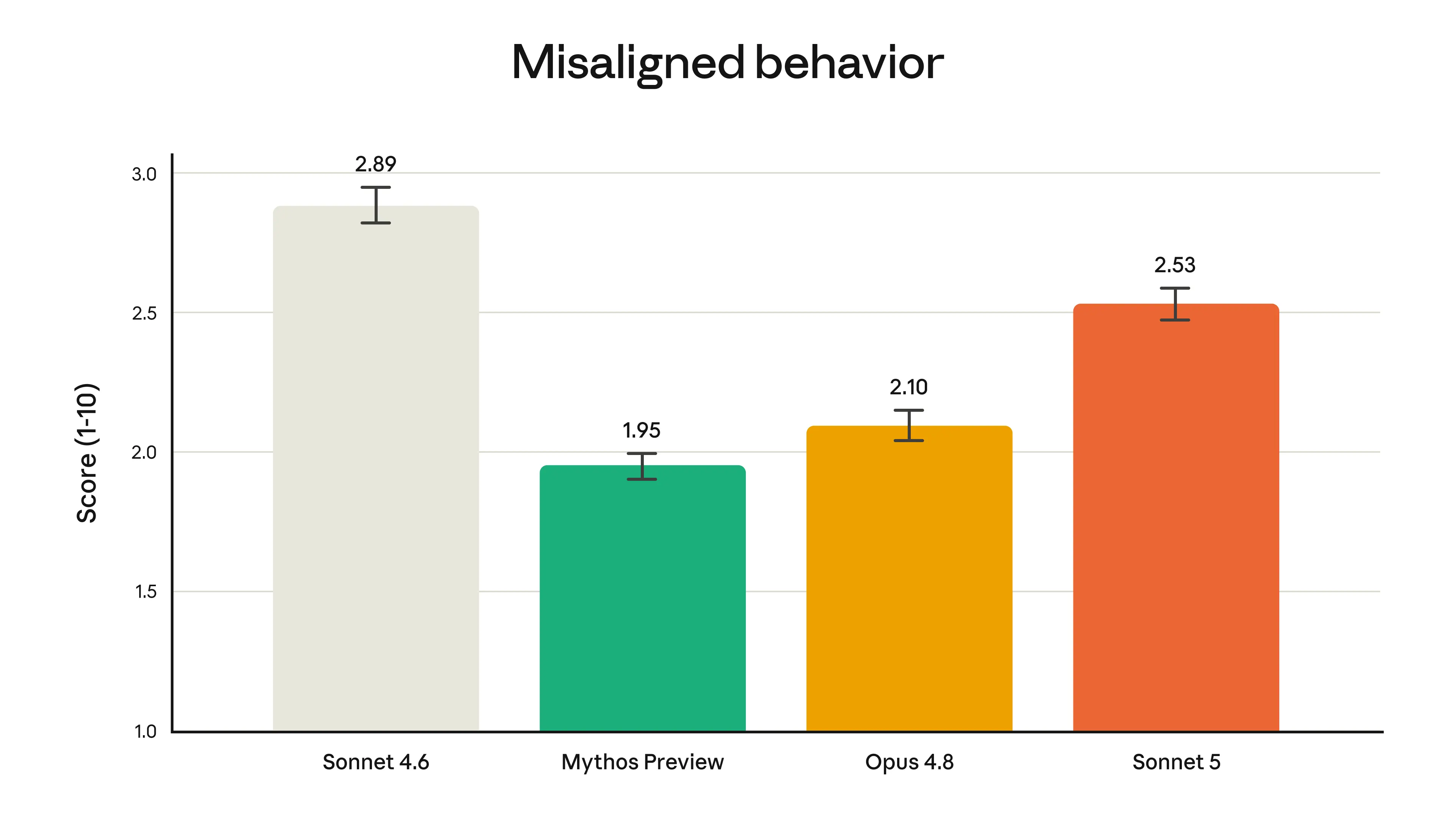
Our pre-deployment safety evaluations found that Sonnet 5 was overall an improvement on Sonnet 4.6. On agentic safety, the model is better at refusing malicious requests and resisting hijack attempts in prompt injection attacks. The model shows lower rates of hallucination and sycophancy than Sonnet 4.6. On our automated behavioral audit, which tests a wide range of misaligned behaviors such as cooperation with misuse and deception, Sonnet 5 scored lower (that is, safer) overall. However, it did show somewhat higher rates of misaligned behavior on this assessment compared to the more capable Opus 4.8 and Claude Mythos Preview.
We did not deliberately train Sonnet 5 on cybersecurity tasks. It can perform some routine, non-harmful cyber tasks, but on evaluations testing potentially dangerous cyber skills, such as developing software exploits, it shows substantially poorer performance than models such as Opus 4.8 and Mythos 5. Scores from one evaluation, which tested models’ ability to develop exploits for vulnerabilities in the Firefox browser, are shown in the chart below. Sonnet 5 was never able to develop a full working exploit, but it does show a slightly higher rate of partial success than Sonnet 4.6. This latter change is likely due to improvements in general intelligence rather than specific training.
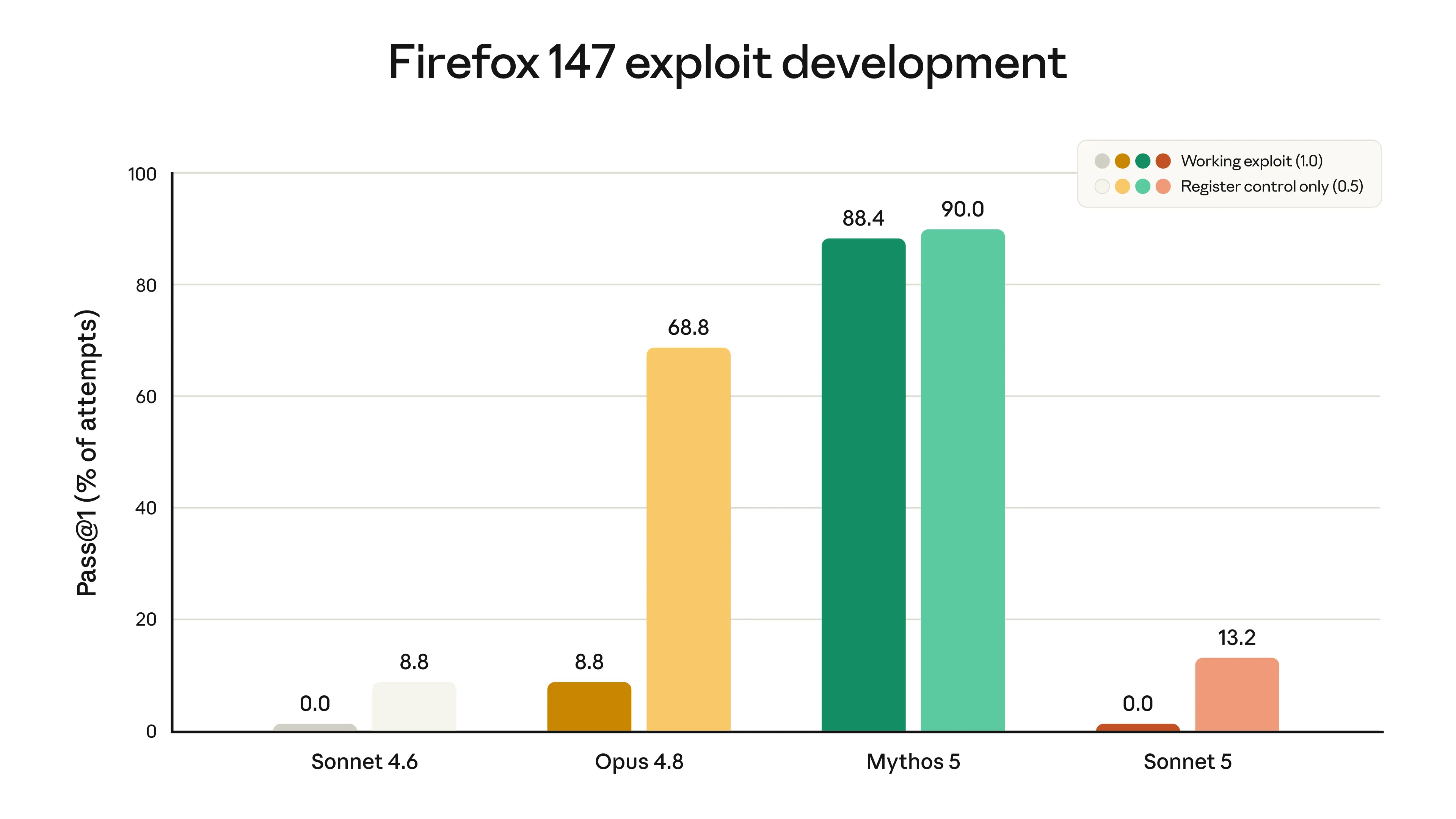
Since Sonnet 5 is somewhat stronger than its predecessor on these tasks, we’ve launched it with cyber safeguards enabled by default. These safeguards—which detect and block dangerous cyber usage in real time—are the same as those present in Claude Opus 4.7 and 4.8 (because we judged that the overall level of cybersecurity risk from Sonnet 5 was low, the safeguards are less strict than those launched with Fable 5, which block a much wider range of cybersecurity tasks).1
Our full assessment of Sonnet 5 across many safety and capability evaluations is reported in the Claude Sonnet 5 System Card.
Availability and pricing
Claude Sonnet 5 is available everywhere today at $2 per million input tokens and $10 per million output tokens2. We’ve increased rate limits across Chat, Cowork, Claude Code, and the Claude Platform3 to accommodate the higher token usage of higher effort levels; users can select whichever level makes sense for their particular project.
Changelog
Edit August 10, 2026: Sonnet 5's introductory pricing of $2 per million input tokens and $10 per million output tokens is now permanent. The standard pricing of $3 input / $15 output previously set to take effect September 1 no longer applies. The pricing references in this post have been updated accordingly.
Edit June 30, 2026: In the original version of this post, we included a cost-performance chart for the BrowseComp evaluation that was based on data from a simpler methodology that did not reflect the standard methodology we use for agentic search evaluations. This had the result of underestimating Sonnet 5's performance on the evaluation.
We have now updated the chart so that it matches the methodology that we used and discussed in the Sonnet 5 system card (which used a 10M token budget with compaction and programmatic tool calling). We have also updated the surrounding text.
Related content
Anthropic invests $100 million to train 10,000 engineers and tackle the enterprise AI talent gap
Anthropic is investing $100 million in Claude Frontier Academy to train 10,000 Frontier Deployed Engineers by the end of 2027, with cohorts from Accenture, Bain, CBA, Deloitte, McKinsey, Morgan Stanley and Novo Nordisk already underway.
Read moreBarclays scales Claude to upgrade operations and improve client experience
Barclays, the British universal bank, is expanding its strategic collaboration with Anthropic to integrate secure, enterprise-grade AI systems across its global operations.
Read moreClaude discovers a novel enzyme system with CRISPR-like repeats
We’re announcing a new life sciences research group and laboratory at Anthropic. This post introduces the team behind this work and shares early results in which Claude discovered a novel enzyme system with properties reminiscent of CRISPR, with only high-level direction from our scientists.
Read more