Claude Sonnet 4.6


Hybrid reasoning model with fast, capable intelligence for real-time agents and high-volume work, featuring a 1M context window
Announcements
- NEW
Claude Sonnet 5.5
A clear upgrade over Sonnet 5 that runs 30% faster and costs up to 30% less for most work.
Read more
Claude Sonnet 5
Our most agentic Sonnet yet. It brings performance that recently required larger, more expensive models to coding, tool use, and everyday work, at Sonnet’s speed and price.
Read more
Claude Sonnet 4.6
Sonnet 4.6 delivers frontier performance across coding, agents, and professional work at scale. It can compress multi-day coding projects into hours and deliver production-ready solutions.
Read more
Claude Sonnet 4.5
Sonnet 4.5 is the best model in the world for agents, coding, and computer use. It’s also our most accurate and detailed model for long-running tasks, with enhanced domain knowledge in coding, finance, and cybersecurity.
Read more
Claude Sonnet 4
Sonnet 4 improves on Sonnet 3.7 across a variety of areas, especially coding. It offers frontier performance that’s practical for most AI use cases, including user-facing AI assistants and high-volume tasks.
Read more
Availability and pricing
Anyone can chat with Claude using Sonnet 5.5 on Claude.ai, available on web, iOS, and Android.
For developers interested in building agents, Sonnet 5.5 is available on the Claude Platform natively, and in Amazon Web Services, Google Cloud, and Microsoft Foundry.
Pricing for Sonnet 5.5 will cost up to an estimated 30% less to run than Sonnet 5 for typical workloads billed by token.
Sonnet 5.5 is priced at $2 per million input tokens and $10 per million output tokens, with up to 90% cost savings with prompt caching and 50% cost savings with batch processing. To learn more, check out our pricing page. To get started, simply use claude-sonnet-5-5 via the Claude API.
For workloads that need to run in the US, US-only inference is available at 1.1x pricing for input and output tokens. Learn more.
Use cases
Sonnet 5.5 is a faster, lower-cost complement to Opus 5.5. It excels at well-scoped everyday tasks across coding, agents, and knowledge work.
API users have fine-grained control over the model’s thinking effort. Popular use cases include:
Coding
Sonnet 5.5 delivers exceptional coding performance across the entire software development lifecycle. It gets up to speed on a codebase quickly, scopes changes before it starts, and keeps edits small enough to review. It’s built for everyday development like building features, fixing bugs, and reviewing code.
Agents
Sonnet 5.5 takes on well-defined agent tasks that need reliable execution, like investigation, review, and drafting. It’s the strongest Sonnet yet on long-horizon tasks, and it needs far fewer tokens than Sonnet 5, making it practical to run repeatedly.
Design and visual work
Sonnet 5.5 is tasteful, with a strong eye for design. It adds polish to user interfaces, creates clearly structured diagrams and user flows, and follows templates to build slides that need minimal editing.
Enterprise workflows
Sonnet 5.5 brings improvements across knowledge work and office tasks, from analysis to documents and slides. Its writing is clearer and more direct, so drafts need less cleanup.
Benchmarks
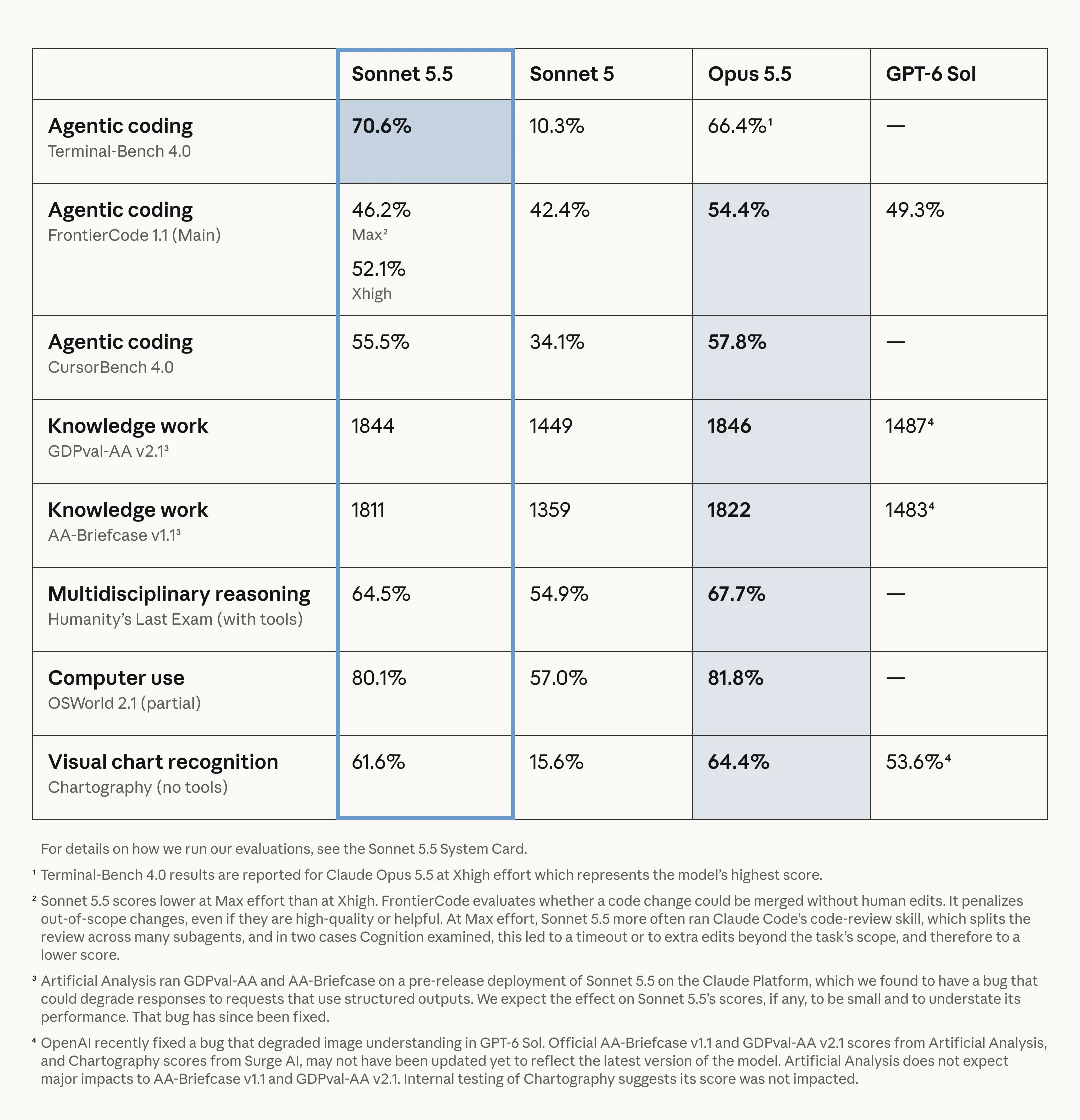
Sonnet 5.5 delivers strong results across the benchmarks that matter most for real-world deployment, from coding, and knowledge work to computer use.
Trust & Safety
We’ve tested and evaluated Sonnet 5.5 against our standards for safety, security, and reliability. The accompanying system card covers safety results in depth.
Hear from our customers

Without changing any of our prompts, Claude Sonnet 5.5 did better than Sonnet 5 on almost all of our offline Slackbot evals, in fewer steps and with about 14% fewer output tokens. When someone gives Slackbot a task, quality and speed are what matter most, and Sonnet 5.5 allows Slackbot to deliver better outcomes for users, faster.

Claude Sonnet 5.5 will give our customers in financial services and healthcare the confidence to use it for their most sensitive work. Sonnet 5.5 rechecks data in source documents, catching errors that Sonnet 5 failed to spot. Compared to the last model, Sonnet 5.5 was more accurate, 2.4x faster, and used 12% fewer total tokens.

At Unity, we have a high bar for task completion. Projects are reopened and results are checked at runtime, so a task only counts when the change works, not when the model says it's done. The majority of Claude Sonnet 5.5's work passed that check. It also completed 90% of tasks in our multi-step Unity Editor and coding benchmark, beating similar models.

Claude Sonnet 5.5 shows better judgment than Sonnet 5 across different levels of complexity, while spending significantly fewer output tokens. Sonnet 5’s tendency to reach for web search too often and its high token use are both gone in this new model. We plan to move simple and moderate reviews over now, and more in the coming weeks.

We fed Claude Sonnet 5.5 hundreds of real support use cases across replies and escalation requests. It made fewer wrong decisions and resolved tickets faster than the Claude models we use in production today. Tickets were processed 20% faster, getting our customers the help they need without the wait.

With millions of AI-assisted actions powering our customers’ workflows each month, execution speed is critical. Claude Sonnet 5.5 will allow teams to run their agents up to 30% faster than they could with Sonnet 5. I’m excited to offer our customers this choice.

Claude Sonnet 5.5 delivers frontier-level performance on CursorBench 4.0 at 55.5%, second only to Opus 5.5. We think it will be a hit with developers looking to balance performance with cost.

In Epic’s early testing, Claude Sonnet 5.5 cleared the same quality bar you’d expect from a higher-tier model, holding up on a system design audit and a data-flow review. The new model managed tens of thousands of lines of code for gameplay system architecture, kept responses snappy, handled multi-hour tasks, and delivered with less prescriptive prompting.

Across 118 real app builds, Claude Sonnet 5.5 produced apps that scored level with Opus 5. It got there in 3.6 iterations per build on average, where Opus 5 took 7.7. It had the fewest failed tool calls of any model we compared. It also rarely stopped mid-build to ask the user a question, so fewer builds stall waiting on someone to answer.

On our private suite of 2,441 finance tasks covering Q&A, extraction, analysis, and forecasting, Claude Sonnet 5.5 scored ahead of Sonnet 5 and used about 121k tokens per answer where Sonnet 5 used 497k. On our analyst search and retrieval work, it was better than Sonnet 5 in almost every way. For high-volume workflows, it had the best quality-to-cost tradeoff of the seven models we ran.

Claude Sonnet 5.5 cooks. Fast at coding and can be steered quickly in iterative workflows. But it can still work long if it needs to. It’s got some of Opus 5.5’s natural writing upgrades, which makes it more fun to work with. I’m switching to it for my day-to-day coding.

Claude Sonnet 5.5 thinks in fewer, more robust steps, so builders wait less to see progress. Our coding evals showed a third fewer tool calls and roughly half the shell runs to finish a task. For everyday coding and higher-effort conversations, that means faster iteration and a smoother build loop.
See Claude in action
Coding
What should I look for when reviewing a Pull Request for a Python web app?
Writing
Create a 3-month editorial calendar template for a weekly newsletter
Students
What’s an effective study schedule template for final exams?
Frequently asked questions
We offer different models across the spectrum of speed, price, and performance. Sonnet 5 delivers top-tier intelligence with optimal efficiency for high-volume use cases. We recommend Sonnet 5 for most AI applications where you need a balance of advanced capabilities and cost-efficient performance at scale. Common use cases include customer-facing agents, production coding workflows, content generation at scale, and real-time research tasks.
Pricing depends on how you want to use Sonnet 5. To learn more, check out our pricing page.