Claude Opus 4.8


Hybrid reasoning model built for serious coding and AI agents, featuring a 1M context window
Announcements
- NEW
Claude Opus 5
A step-change improvement for the Opus tier: stronger coding, more capable agents, and sharper professional work.
Read more
Claude Opus 4.8
May 28, 2026
Stronger across coding, agentic tasks, and professional work, Opus 4.8 has the consistency and autonomy to keep working on long-running tasks.
Read more
Claude Opus 4.7
Apr 16, 2026
Claude Opus 4.7 brings stronger performance across coding, vision, and complex multi-step tasks. It's more thorough and consistent on difficult work, with better results across professional knowledge work.
Read more
Claude Opus 4.6
Feb 5, 2026
Claude Opus 4.6 is our most capable model to date. Building on the intelligence of Opus 4.5, it brings new levels of reliability and precision to coding, agents, and enterprise workflows.
Read more
Claude Opus 4.5
Nov 24, 2025
Claude Opus 4.5 is our most intelligent model to date. It sets a new standard across coding, agents, computer use, and enterprise workflows. Opus 4.5 is a meaningful step forward in what AI systems can do.
Read more
Availability and pricing
Claude Opus 5 is our strongest Opus model yet powering long-running, highly capable agents while delivering improvements in coding and professional work.
For business users and consumers who want to collaborate with a powerful model on complex tasks, Opus 5 is available on Claude for Pro, Max, Team, and Enterprise users.
For developers interested in building AI solutions that demand strong intelligence, Opus 5 is available on the Claude Platform natively, and in Amazon Web Services, Google Cloud, and Microsoft Foundry.
Pricing for Opus 5 starts at $5 per million input tokens and $25 per million output tokens, with up to 90% cost savings with prompt caching and 50% savings with batch processing. To learn more, check out our pricing page. To get started, use claude-opus-5 via the Claude API.
For workloads that need to run in the US, US-only inference is available at 1.1x pricing for input and output tokens. Learn more.
Use cases
Opus 5 is a premium model for serious coding and knowledge work. It delivers the quality and reliability professionals depend on for software engineering, agentic workflows, and high-stakes enterprise tasks.
With effort settings, you control how hard Opus 5 works — it reaches its best performance at higher effort on your highest-value tasks, and runs at much lower cost on tasks that don’t need the ceiling of its capabilities. Popular use cases include:
Advanced coding
Opus 5 can confidently deliver production-ready code with minimal oversight. It plans carefully, sustains long-running work, and operates reliably in large code bases. It catches its own mistakes, so senior engineers can delegate their hardest coding work with confidence.
AI agents
Opus 5 powers production agentic workflows, orchestrating complex multi-tool tasks with consistent reliability. It runs longer and more autonomously than previous Opus models, planning deliberately, verifying its own work, and driving ambitious projects forward with minimal oversight.
Enterprise workflows
Opus 5 sets the standard for enterprise workflows, carrying context across sessions to manage complex, multi-day projects end-to-end with professional polish and strong performance on spreadsheets, slides, and docs.
Benchmarks
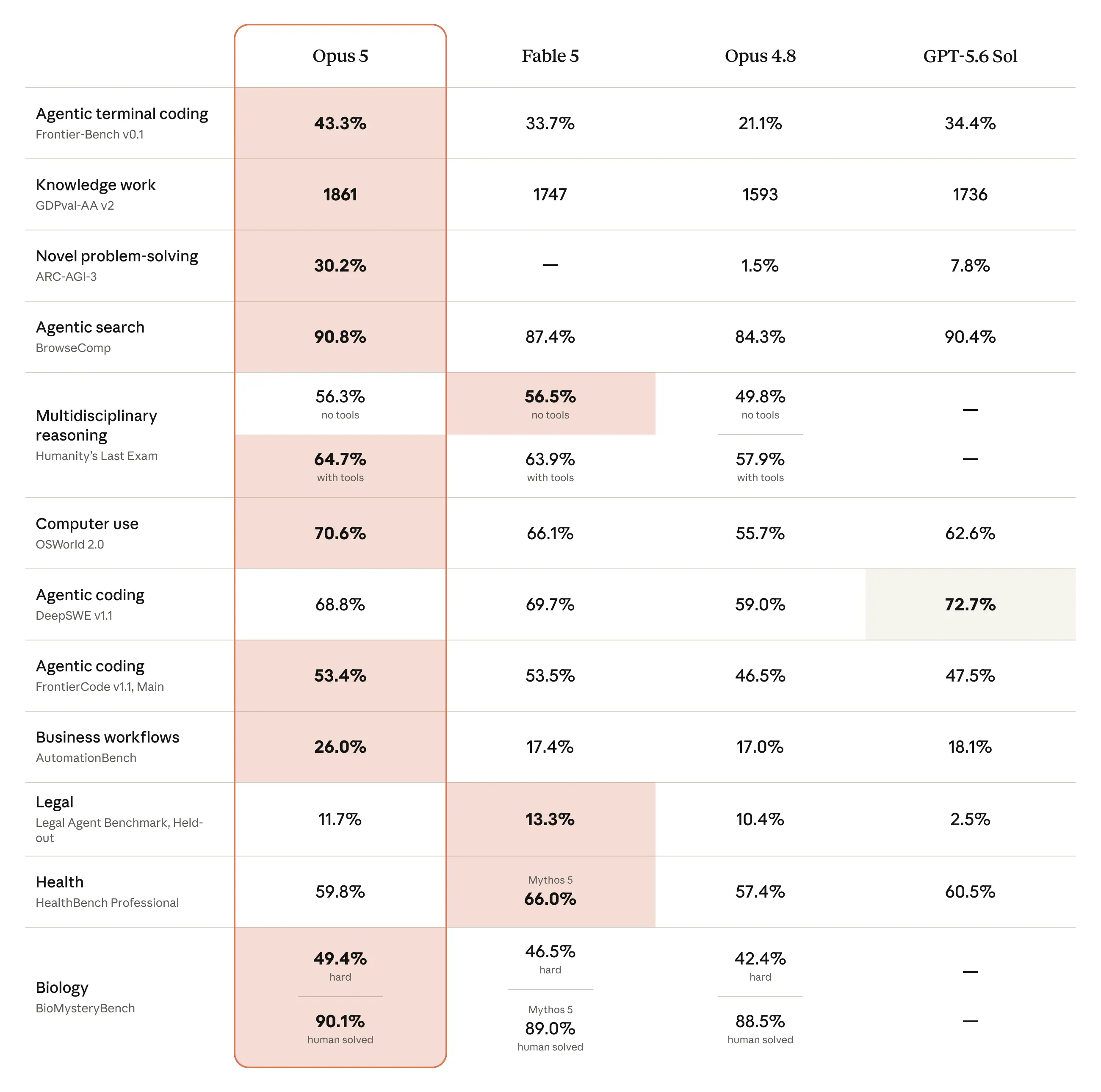
Claude Opus 5 delivers the intelligence and reliability to be your daily driver for serious coding and knowledge work.
Trust and safety
Extensive testing and evaluation ensures the release of Opus 5 meets Anthropic’s standards for safety, security, and reliability. The accompanying model card covers safety results in depth.
Hear from our customers

On FrontierCode 1.1, Claude Opus 5 approaches Fable-level performance at half the cost. Within Devin, it also shows particular strength on difficult debugging and root-cause analysis tasks.

Claude Opus 5 delivers near Fable 5 intelligence at Opus speed and cost. On CursorBench it’s just under Fable 5 and has many of the same behaviors. We are excited to see how developers use it in Cursor.

Claude Opus 5 topped Zapier’s AutomationBench leaderboard without spending more tokens than prior Claude models. It took a raw account-health workbook and ran a full churn-prevention sequence end to end: flagging at-risk accounts, alerting the right owner, and summarizing for retention ops. Previous models didn’t pass; Opus 5 hit 100%.

On our genomics analysis work, Claude Opus 5 behaves more like a careful scientist than any model we’ve run. It reaches for the right statistical tests to rule out confounders, cross-checks its own results by independent methods, and stays on track through long multi-step analyses.

Claude Opus 5 came out ahead of every model in its family on our internal evals. It isn’t just better on our hardest agentic coding tasks, up 22% over Opus 4.7, it’s steadier, with far less variance run to run. For the millions of builders on Lovable, that consistency is the whole game. Reliable results, build after build.

Claude Opus 5 is the biggest leap in the Opus family since 4.5. On the same full-stack app builds, the front end shows it first: the best animations, games, and 3D work we have seen from an Opus model.

We’re loving Claude Opus 5. For the kind of open-ended analytical work our agent handles, it’s a strict upgrade over Opus 4.8, and the gains are biggest exactly where it matters: the harder, vaguer tasks. Responses are clearer and more concise, and we see improved efficiency at higher effort levels too.

Claude Opus 5 is a striking improvement over Opus 4.8 for the financial research workflows our analysts run every day. It stands out on numerical reasoning, table work, and sharper critical thinking where precision matters.

Claude Opus 5 delivers the industry intelligence and accuracy that is essential for the analysis of specialized enterprise content. Box found that Opus 5 outperforms Opus 4.8 by 8% and delivers notable performance gains in the data analysis (11% improvement) and due diligence (17% improvement) workflows that technology, healthcare, and public sector organizations rely on daily.

Claude Opus 5 is a clear generational step up from Opus 4.8. Over one weekend I gave it a chief-of-staff role over my dev environments: it built its own monitor, drove each box, and pulled me in only for the judgment calls.

Claude Opus 5 made large scale changes across our Fundamental Research Assistant codebase, adapting to feedback throughout an agentic workflow and explaining its reasoning more clearly than any model we’ve used. It handled work we would normally have broken into much smaller pieces.

On some of our hardest financial-modeling tasks, Claude Opus 5 is a clear step up from Opus 4.8 in both accuracy and efficiency. Its performance floor is materially higher, especially on deep finance domain logic. Across effort levels it averaged 9 percentage points higher accuracy with a third fewer turns and tool calls and 60% less time.

Claude Opus 5 checks its own work the way a real frontend developer would. On our benchmark it opened its pages in a browser at desktop and phone widths, caught a product hidden below the mobile fold and an off-screen checkout button, and fixed both before handing the work back.

Claude Opus 5 is a clear step up in performance on legal agent work compared to prior Opus models, and we saw the biggest gains in practice areas like corporate governance and arbitration. We were also impressed with Opus 5’s ability to maintain quality at lower reasoning levels, achieving similar performance while generating 26% fewer tokens on average compared to Opus 4.8 at max reasoning.

Claude Opus 5’s biggest gains for us are on longer-horizon work: building a full deck, then revising it. Artifact quality is what decides which model we ship, and this is the clearest step up we’ve seen — better visual understanding, cleaner formatting, fewer slide issues.

Claude Opus 5’s judgment is what stands out. Handing off a PR, it doesn’t rush to publish: it verifies the branches, checks the template, and thinks through test implications so the handoff is clean. The older models tended to jump ahead and get caught on our checks.

During a rearchitecting session, Claude Opus 5 pushed back on a design I proposed, and it didn’t fold when I insisted. Instead, it explained exactly what was valuable in my idea, narrowed its objection to a single design question, and proposed a compromise that kept the good part while fixing the flaw. That’s the kind of judgment that lets us trust it with less oversight.

On first-turn redlines, Claude Opus 5 scored the highest of any model we tested, nearly double Opus 4.8. Commenting is better too: on NDAs it gets to the redline in less time and with fewer passes, with accuracy maintained or better.

Claude Opus 5 writes clean, tight diffs with no dead code, and it’s the stronger hazard spotter on subtle, codebase-specific issues. We’re adopting it for production workloads.

We will definitely migrate a number of use cases in Cosmos, our unified agent platform. We’re looking forward to increasingly using Claude Opus 5 for code review, and I am confident in saying we would rather people be using Opus 5 than Opus 4.8.

What stands out about Claude Opus 5 is judgment. It thinks harder before it writes a single line, catches its own logical faults during planning rather than after the fact, and reasons about why an answer is right, not just whether it works. It’s the clearest jump in problem-solving we’ve seen from one Claude model to the next, and we’re looking forward to seeing it adopted in JetBrains IDEs.

Claude Opus 5 is the strongest Opus model we’ve tested on our trading benchmark, and it gets there using roughly a seventh of the reasoning tokens and under half the latency of Opus 4.8. Better answers at a fraction of the compute.

Claude Opus 5 lets monitoring agents manage parts of their own memory in production, making them more autonomous and reliable over longer horizons. The agent treats its context as a living document: after flagging a potential anomaly in one of our services, it re-checked its own assumption against production, found the signal was benign, wrote the correction into its memory, and retired its monitoring queries on its own.

Claude Opus 5 is a strong agentic coding model built for long-running, multi-step work. It deeply understands your codebase, holds the thread across complex tasks, and pins down requirements for feature development and bug-fixing more effectively than Opus 4.8. Developers can now build with Opus 5 in Kiro, accessing its advanced capabilities to tackle ambitious projects.
Frequently asked questions
We offer Claude models across the spectrum of speed, price, and performance. We recommend Opus 5 for your most demanding use cases where you need frontier intelligence—particularly production-ready code, sophisticated AI agents, and complex document creation.
Pricing depends on how you want to use Opus 5. To learn more, check out our pricing page.